One board. Native execution at the edge.
A small Go server and clients coordinate work while native tools retain execution, sign-in and permissions on their own devices.
DiscoveryControl routeRelationshipsSources of truthPending proof
Discovery observes; it does not control
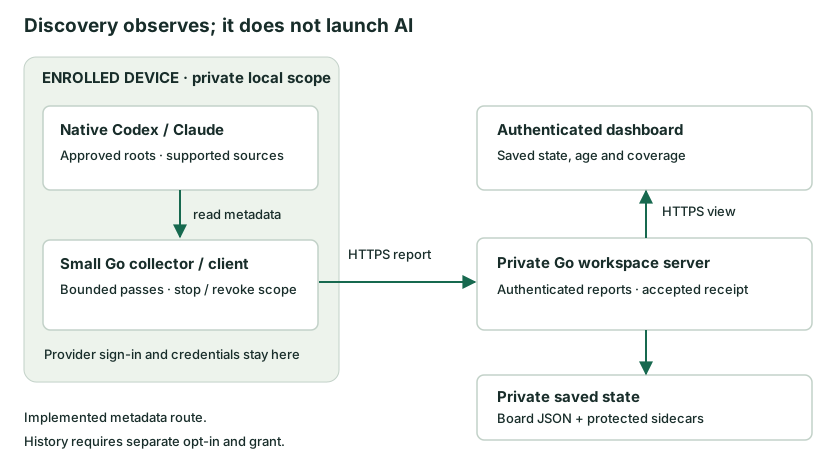
The collector reads only supported native sources within approved same-user roots and reports bounded metadata over authenticated HTTPS. History requires a separate opt-in and grant. The server persists accepted state; browser views show that state and its age. A collector is deterministic, so unchanged polling does not call a model.
The CEO and destination control route
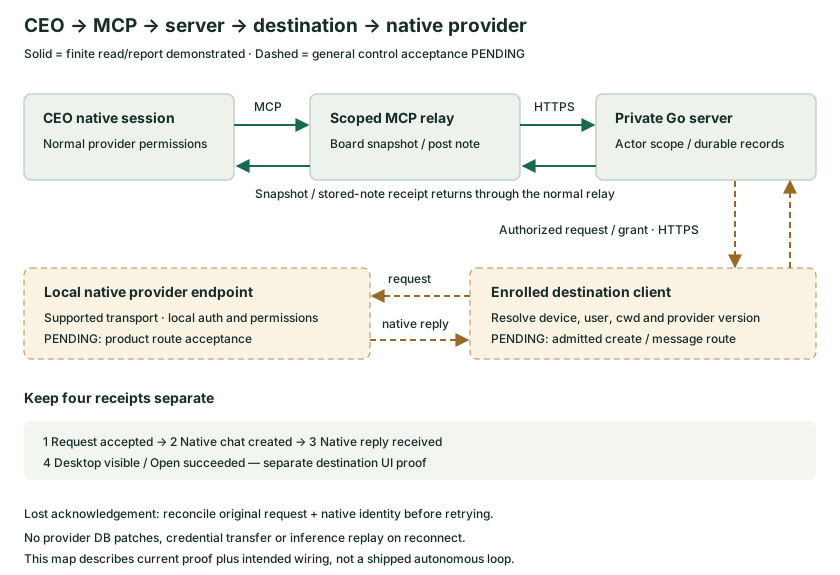
A CEO is a real native provider session using scoped MCP tools. The demonstrated tools read a board and post an attributed note through the normal relay. Server authorization limits which actor can access which board/task/session; ordinary native provider permissions still govern execution. Optional custom hardening is a separate concern.
For the intended create/message route, the server records an authorized request; the enrolled destination client resolves its local provider and project and owns the supported native transport. Request acceptance, native creation, native reply and Desktop Open are four separate receipts. Source contains request/grant/claim/event machinery, but that alone does not establish a generally deployed control workflow.
If delivery becomes uncertain, reconcile the original request and native identity before another attempt. A separate-runtime resume must not masquerade as attachment to an active original turn. Provider databases are not patched to force visibility.
Logical relationships
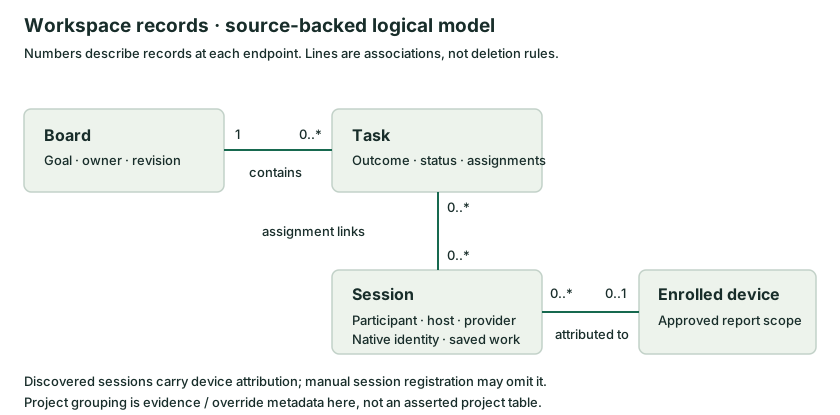
The current Go workspace stores boards, tasks and sessions in private JSON state; protected history/question storage is separate. Task assignments contain session references. A session retains participant, host, provider and native identity; device attribution is present for discovery and can be absent for manual registration. Project evidence and owner overrides are grouping metadata, not a physical project table in this diagram.
Sources of truth and derived views
| Fact | Authority | Derived or limited evidence |
|---|---|---|
| Task goal, assignment, acceptance | Private DELEGATOR board | Summaries and progress labels need supporting proof. |
| Native execution and approvals | Original supported native provider channel | A catalog row, PID or report receipt does not establish native state. |
| Device reporting freshness | Server acceptance timestamp and enrollment | Online/fresh does not mean working. |
| Code change or CI result | GitLab repository/MR/commit/pipeline | Cached external evidence and explicit links do not accept a task. |
| History | Captured private generation plus its provenance and coverage | Transport completion is not complete native backup. |
| Public status | Reviewed dated documentation | A curated snapshot, not a live private-data feed. |
What still needs proof
- Destination control: one authorized native create/reply on the correct device, duplicate-safe replay and separate actual Desktop Open.
- Durable continuity: versioned handoffs and reliable successor attribution without automatic replacement from weak signals.
- History completeness: compatible installed capture, full requested coverage and truthful partial/recovery behavior.
- Automatic coordination: scoped useful actions, allowance admission, one-child limits, recovery and native permission waits under real execution.
These are accepted outcomes or engineering work, not settled implementation claims. The delivery owner retains acceptance responsibility. See the dated status for the current boundary.